An article in song:
Discover
I want to talk about a novel about a fascinating myth of the Middle Ages, Le Roman de Melusine . I only read the version of Coudret (finally, a translation, not speaking French means!).

The back cover *
Melusine's story belongs to the folklore and the universal part of the long line of stories that expose the human world and the supernatural world through] the union of a mortel et d'une fée, Après avoir longtemps appartenu à la tradition orale, c'est au Xiie siècle que la légende fait son entrée en littérature, tandis que la fée devient l'ancêtre mythique des Lusignan au début du Xive siècle, sous la plume de Pierre de Bressuire:
"On raconte dans ma patrie que la solide forteresse de Lusignan a été fondée par un chevalier et la fée qu'il avait épousée, et que la fée elle-même est l'ancêtre d'une multitude de nobles et de grands personnages, et que les rois de Jérusalem et de Chypre, ainsi que les comtes de la Niarche et de Parthenay sont ses descendants... Mais la fée, dit-on fut surprise nue par son mari et Ne transforma en serpente. Et aujourd'hui encore l'on raconte que quand le château change de maître, le serpent se montre dans le château. "
Seul manque dès lors à notre légende le nom de la fée, apparu un siècle plus tard dans les deux romans français, le récit en prose de jean d'Aras (1393) et le texte en vers de Coudrette (début du Xve siècle) : deux histoires écrites à la gloire du lignage des Lusignan autrefois prestigieux, sur fond de guerre franco-anglaise et de reconquête du Poitou par le duc de Berry, et imprégnées du mythe de la croisade, deux conte de fées voués, de siècle en century, a continuing success.
My opinion
edition of GF-Flammarion, presented, translated and annotated by Laurence Harf-Lancner provides a record of "the ancestors of Melusine," that is to say a few texts which have inspired the legend. This should be interesting for the university, but a bit inaccessible for the commom mortal, the case with very little explanation.
A more complete introduction can hopefully better situate the story in time and space, and learn more about the different versions of literary myth.
La légende, en tant que telle, a ses hauts et ses bas.
De fait, j'aimais surtout lire les passages avec Mélusine et son mari Raymondin. Mais les loooongs moments épiques où les fils du couple vivent des aventures incroyables - consistant surtout à tuer du musulman - je m'en suis lassée dès les premières phrases. Certains moments trouvaient un sens en s'inscrivant dans la destinée des principaux protagonistes (Fromond rentrant chez les moines et le massacre de l'abbaye par Geoffroy qui amène la perte; le tombeau du père de Mélusine découvert par Geoffroy) et devenaient par le fait-même très intéressants, mais le reste était surtout de Christian propaganda averaging.
The wonderful transcends the work, becoming common among the characters. I especially loved when Melusine offers Raymondin earth. The leather strap that transforms into a river, these troubadours and these nobles appeared from nowhere came to party and serve the king, delighted me as ever.
If you're curious, I suggest you get a different versions of the legend of Melusine. I spent very good moments during her reading. If you are like me in your fancy places for reading, it's a perfect book to read in a bathtub or near water (near a river for example ^ ^), Melusine is after all the Fairy Fountain. :)
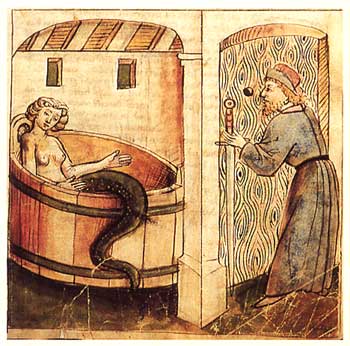
The bath Melusine RINGOLTINGEN Von Th / die der Geshichte MelusineNüremberg scone, Nat. Mus. 4028 ms
Myth
Besides the novel, and psychoanalytic interpretations as some have done, this story is inspired by an ancient myth that has marked the memories to the point of having law a Christianized version here (and not just a little!). The origin of Melusine has spilled much ink, both yesterday and today, and this resulted in many theories.
For example, if one tries to trace the etymology of his name, we come across some interesting results: **
- according to the account of Jehan d'Arras "Melusine" meaning "prodigy" or "prodigious."
- Littré suggests Latin Melusi "melodious, pleasing".
- Bullet offers a mid-lysowen Celtic root, "half-snake."
- selon Léo Desaivre, "Merlusine" désignerait la "mère des Lusignan".
- Henri Dontenville suggère entre autres la racine mar, mer, mel qui en ferait une "dame des eaux", une "dame de la fontaine", ou encore "mère Lucine", d'après une désignation de Junon en tant que protectrice des accouchements : Lucina.
- Lusine/Lucine renvoie à la racine latine lux, "lumière", et au nom du dieu celte Lug.
- P. Martin-Civat parle de "mère l'eusine", d'après le nom poitevin du chêne vert, de l'yeuse, et il fait de la Mélusine primitive a divinity of the oak.
- Felix Liebrecht refers to a designation of Artemis: Melissa, and cites the influence Marseille.
- E. Blacher offers an opening to the Hindu goddess Miluschi , the 'generous', whose mother would be the equivalent of Pricna Pressine.
- was also attached to Melusine old silver mines of Melle in the Deux-Sevres.
- Jean Markale seems to define the character from Greek melas - leukos, the "White-Black".
Melusine is the centerpiece of a fascinating myth, a figure rich evoking both the succubus and siren, and the fairy goddess. Melusine rises in the human psyche to reveal himself to us as an archetype with many facets:
"Woman, fairy, snakes and flies, it partakes of all elements of all kinds. Always present, it asserts itself as an inexhaustible medium of reflection on the nature and purpose of man.
every indication that she is the heir to ancient beliefs. More than a nymph, she is a true divinity of water. And it appears as a mother goddess, revered in ancient times, and perhaps on distant lands ** ".
iconography
*** A website tells perfectly the iconography of the fairy Melusine, through both Christian and pagan representations. I invite you to go take a little trip, it's very interesting and eventful.
Excerpts

Woman with Serpent's Tail
statue of the early sixteenth century (Finistère). The
Serpente joined the queue behind the braid of the Virgin without being able to distinguish between one and another.

Isis Thermoutis
Terracotta Museum, Cairo.

facade of the Hotel de Ville La Rochelle (Charente-Maritime).
The number of representations of Melusine is as varied as its symbolic itself. Sometimes she is the Virgin Mary, the pillar that allows Christ to stand, the temptation of the serpent of Eden lost, builder, siren, snake, succubus, shadow trade secrets, protective light, androgynous woman, man, mother goddess, God sea, etc. ...
Melusine is as mysterious as his legend, and historians / mythologists still have not finished discovering its secrets.
Sources
*
Coudret, Melusine's novel, the text presented, translated and annotated by Laurence Harf-LANCER, GF-Flammarion, 1993, Paris, 194 p.
** http://www.mythofrancaise.asso.fr/mythes/figures/MEfiche.htm
***
http://regorm.free.fr/expo/expo.html


0 comments:
Post a Comment